
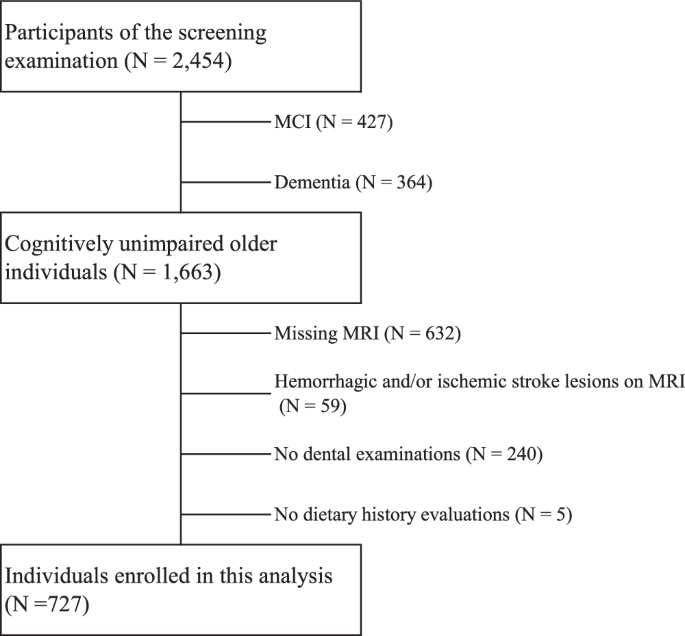
Participant characteristics
This study included 727 participants, with 598 (82.3%) engaging in social eating and 129 (17.7%) in solitary eating. In Table 1, the mean age of the total sample was 70.32 years, with the solitary eating group (71.17 ± 7.09 years) being slightly older than the social eating group (70.07 ± 6.30 years), though this difference was not statistically significant. Women comprised 56.8% of the total sample, with similar proportions in both eating style groups (social: 57.1%, solitary: 55.8%). Health indicators showed no significant differences between the two groups. Hypertension prevalence was comparable (social: 52.1%, solitary: 53.5%). Mean serum LDL cholesterol levels (social: 116.21 ± 32.48 mg/dL; solitary: 113.58 ± 33.26 mg/dL) and HDL cholesterol levels (social: 61.47 ± 15.06 mg/dL; solitary: 59.68 ± 15.56 mg/dL) were also similar. The prevalence of diabetes mellitus did not differ significantly between social (15.2%) and solitary (16.3%) eaters.
Participants in both groups had comparable educational backgrounds, with mean years of formal education being 11.35 ± 2.23 for social eaters and 11.41 ± 2.28 for solitary eaters. Body Mass Index (BMI) was also similar between the groups (social: 23.80 ± 3.24; solitary: 23.87 ± 3.71). Lifestyle factors showed apparent differences, but these were not statistically significant. The prevalence of smoking was higher in the solitary eating group (15.5%) compared to the social eating group (10.2%). Similarly, exercise habits were more common among social eaters (45.4%) than solitary eaters (39.8%).
Brain volume differences between social and solitary eating styles
All brain region volumes were normalized to the estimated total intracranial volume (eTIV) and expressed as a percentage to account for individual differences in head size. In Table 2, we observed differences in the regional brain between social and solitary eating styles, after adjusting for various confounding factors and applying Bonferroni correction for multiple comparisons across the combined hemisphere brain regions. Total brain volume (TBV) was lower in the solitary eating group (58.28%, 95% CI: 57.76–58.80) compared to the social eating group (59.02%, 95% CI: 58.77–59.26), with an F-value of 6.31 and -log10(p) of 1.91. Several specific brain regions also showed smaller volumes in the solitary eating group compared to the social eating group. These regions included the medial temporal lobe (1.812% vs 1.852%, F = 5.93, -log10(p) = 1.82), parietal lobe (5.918% vs 6.019%, F = 5.44, -log10(p) = 1.70), occipital lobe (2.375% vs 2.437%, F = 8.98, -log10(p) = 2.55), insula (0.817% vs 0.833%, F = 4.49, -log10(p) = 1.46), and hippocampus (0.473% vs 0.484%, F = 4.69, -log10(p) = 1.51). The occipital lobe demonstrated the most pronounced difference between groups, with the highest F-value (8.98) and the lowest p-value (-log10(p) = 2.55) among all examined brain regions. Other brain regions, including white matter hyperintensities (WMH), frontal lobe, lateral temporal lobe, cingulum, and amygdala, did not show statistically significant differences between the two groups, with -log10(p) values ranging from 0.24 to 1.11.
Table S1 provides a comprehensive analysis of regional brain volume differences between social and solitary eating styles. Several cortical regions showed significantly smaller volumes in the solitary eating group compared to the social eating group. In the left hemisphere, these included the cuneus (F = 5.86, -log10(p) = 1.80), isthmuscingulate (F = 8.65, -log10(p) = 2.47), lingual (F = 4.14, -log10(p) = 1.38), middle temporal (F = 4.51, -log10(p) = 1.47), pericalcarine (F = 13.94, -log10(p) = 3.69), and transverse temporal (F = 3.95, -log10(p) = 1.33) areas. In the right hemisphere, significant differences were observed in the entorhinal (F = 6.48, -log10(p) = 1.95), fusiform (F = 4.49, -log10(p) = 1.46), isthmuscingulate (F = 11.67, -log10(p) = 3.17), lateral occipital (F = 6.52, -log10(p) = 1.96), pericalcarine (F = 6.64, -log10(p) = 1.99), and precuneus (F = 8.66, -log10(p) = 2.47) regions. The pericalcarine cortex in the left hemisphere showed the most pronounced difference among all cortical regions (F = 13.94, -log10(p) = 3.69). Among subcortical structures, the left putamen (F = 5.36, -log10(p) = 1.68) and left hippocampus (F = 4.86, -log10(p) = 1.56) demonstrated significantly smaller volumes in the solitary eating group. Broader brain measures also revealed significant differences. The solitary eating group showed reduced volumes in total cortical gray matter (F = 4.57, -log10(p) = 1.48), subcortical gray matter (F = 5.42, -log10(p) = 1.69), and total gray matter (F = 5.30, -log10(p) = 1.67). Both left (F = 4.17, -log10(p) = 1.38) and right (F = 4.85, -log10(p) = 1.55) hemisphere cortical gray matter volumes were significantly smaller in the solitary eating group.
Differences in nutrient intake between social and solitary eating styles
Table 3 presents a comprehensive analysis of nutrient intake differences between social and solitary eating styles, after adjusting for various confounding factors and applying Bonferroni correction for multiple comparisons. Significant differences were observed in macronutrient intake between the two groups. The solitary eating group showed lower protein intake (F = 8.46, -log10(p) = 2.43) compared to the social eating group. Conversely, the solitary group had a higher carbohydrate energy ratio (F = 4.85, -log10(p) = 1.55) and alcohol consumption (F = 4.94, -log10(p) = 1.58). Polyunsaturated fatty acid intake was lower in the solitary eating group (F = 4.52, -log10(p) = 1.47).
Several micronutrients showed significantly lower intake in the solitary eating group. These included vitamins such as beta-carotene equivalent (F = 9.68, -log10(p) = 2.71), vitamin B6 (F = 9.37, -log10(p) = 2.64), folic acid (F = 8.50, -log10(p) = 2.44), pantothenic acid (F = 7.26, -log10(p) = 2.14), vitamin K (F = 6.40, -log10(p) = 1.94), alpha-tocopherol (F = 5.02, -log10(p) = 1.60), and vitamin C (F = 4.02, -log10(p) = 1.34). Minerals such as iron (F = 8.47, -log10(p) = 2.43), potassium (F = 7.13, -log10(p) = 2.11), copper (F = 7.06, -log10(p) = 2.09), zinc (F = 6.03, -log10(p) = 1.84), and magnesium (F = 4.16, -log10(p) = 1.38) also showed lower intake in the solitary eating group.
The solitary eating group exhibited lower intake of several fatty acids, including N-3 polyunsaturated fatty acids (F = 9.30, -log10(p) = 2.62), behenic acid (F = 8.51, -log10(p) = 2.44), octadecadienoic acid (F = 8.41, -log10(p) = 2.42), and alpha-linolenic acid (F = 3.90, -log10(p) = 1.31). Additionally, lower intake of various amino acids was observed in the solitary eating group, including glycine (F = 8.58, -log10(p) = 2.45), tryptophan (F = 5.74, -log10(p) = 1.77), cystine (F = 5.39, -log10(p) = 1.69), histidine (F = 5.15, -log10(p) = 1.63), and arginine (F = 3.97, -log10(p) = 1.33).
Total dietary fiber intake was lower in the solitary eating group (F = 6.08, -log10(p) = 1.86), as was insoluble dietary fiber (F = 5.78, -log10(p) = 1.78). Notably, the solitary eating group showed lower intake of surplus ammonia (F = 10.75, -log10(p) = 2.96), nitrate ion (F = 8.58, -log10(p) = 2.45), and mannitol (F = 8.42, -log10(p) = 2.42). However, they had higher intake of sucrose (F = 5.41, -log10(p) = 1.69) and maltose (F = 5.19, -log10(p) = 1.64).
Differences in food and beverage intake between social and solitary eating styles
Table 4 presents a detailed analysis of food and beverage intake differences between social and solitary eating styles, after adjusting for various confounding factors and applying Bonferroni correction for multiple comparisons. Significant differences were observed in the consumption of various food and beverage items between the two groups. The solitary eating group showed higher intake of several items compared to the social eating group. Most notably, whisky consumption was markedly higher in the solitary eating group (F = 16.41, -log10(p) = 4.25). Other items with significantly higher intake in the solitary group included white sugar (F = 14.89, -log10(p) = 3.90), table salt (F = 13.51, -log10(p) = 3.59), and saccharides (F = 12.81, -log10(p) = 3.43).
Interestingly, the solitary eating group also showed higher consumption of certain beverages and processed foods. These included green juice kale (F = 10.99, -log10(p) = 3.02), instant noodles (F = 7.03, -log10(p) = 2.09), sweet sake (F = 6.81, -log10(p) = 2.03), noodles in general (F = 6.40, -log10(p) = 1.93), and regular cow’s milk (F = 4.62, -log10(p) = 1.50). Conversely, the solitary eating group demonstrated lower intake of several food items compared to the social eating group. Notably, there was a significant reduction in the consumption of vegetables and plant-based foods. Potato intake was lower (F = 13.42, -log10(p) = 3.57), as was the consumption of mushrooms (F = 10.89, -log10(p) = 2.99), soybean miso (F = 10.68, -log10(p) = 2.95), other vegetables (F = 7.66, -log10(p) = 2.24), vegetables not high in beta-carotene (F = 7.59, -log10(p) = 2.22), and vegetables high in beta-carotene (F = 6.05, -log10(p) = 1.85). The solitary eating group also showed lower intake of certain animal-based foods, including shellfish (F = 10.41, -log10(p) = 2.88), beef (F = 6.49, -log10(p) = 1.96), and pork (F = 4.75, -log10(p) = 1.53). While the solitary group consumed more noodles and breads, they had a lower intake of regular soy sauce (F = 4.27, -log10(p) = 1.41), which is commonly used as a condiment in many Asian cuisines.
Regional brain volume differences between social and solitary eating styles after adjusting for nutrient intake
Table 5 presents the differences in regional brain volumes between social and solitary eating styles after adjusting for multiple confounding factors, including age, sex, educational level, hypertension, diabetes mellitus, BMI, smoking, exercise habits, LDL and HDL cholesterol levels, and 5 nutrient intake variables with significant differences in Table 3 and acceptable multicollinearity (VIF < 10).
After this comprehensive adjustment and applying Bonferroni correction for multiple comparisons, several brain regions still showed significant differences between the social and solitary eating groups. The medial temporal lobe volume was significantly smaller in the solitary eating group (1.826%, 95% CI: 1.796–1.857) compared to the social eating group (1.852%, 95% CI: 1.848–1.865), with F = 3.87 and -log10(p) = 1.31. The parietal lobe also demonstrated a significantly smaller volume in the solitary eating group (5.920%, 95% CI: 5.847–6.004) compared to the social eating group (6.023%, 95% CI: 5.997–6.060), with F = 5.25 and -log10(p) = 1.65. The occipital lobe showed the most pronounced difference, with a significantly smaller volume in the solitary eating group (2.384%, 95% CI: 2.345–2.424) compared to the social eating group (2.447%, 95% CI: 2.429–2.454). This difference had the highest F-value (6.69) and p-value (-log10(p) = 2.00) among all examined brain regions. The insula demonstrated a significantly smaller volume in the solitary eating group (0.820%, 95% CI: 0.807–0.834) compared to the social eating group (0.833%, 95% CI: 0.837–0.840), with F = 5.18 and -log10(p) = 1.64.
Interestingly, the difference in hippocampal volume between the two groups was no longer statistically significant after adjusting for nutrient intake (F = 2.43, -log10(p) = 0.92). Similarly, other brain regions, such as the total brain volume (TBV), did not show statistically significant differences between the social and solitary eating groups after this comprehensive adjustment.
Regional brain volume differences between social and solitary eating styles after adjusting for food and beverage intake
Table 6 presents the differences in regional brain volumes between social and solitary eating styles after adjusting for multiple confounding factors, including age, sex, educational level, hypertension, diabetes mellitus, BMI, smoking, exercise habits, LDL and HDL cholesterol levels, and 28 food and beverage intake variables with significant differences in Table 4 and acceptable multicollinearity (VIF < 10).
After this comprehensive adjustment for food and beverage intake and applying Bonferroni correction for multiple comparisons, two brain regions maintained significant differences between the social and solitary eating groups. The medial temporal lobe volume remained significantly smaller in the solitary eating group (1.814%, 95% CI: 1.783–1.845) compared to the social eating group (1.852%, 95% CI: 1.848–1.876), with F = 4.61 and -log10(p) = 1.49. The occipital lobe continued to show the most pronounced difference, with a significantly smaller volume in the solitary eating group (2.385%, 95% CI: 2.345–2.435) compared to the social eating group (2.447%, 95% CI: 2.429–2.454). This difference had the highest F-value (5.11) and p-value (-log10(p) = 1.62) among all examined brain regions.
Notably, the hippocampus, which showed significant differences in previous analyses, no longer demonstrated a statistically significant difference between the two groups after adjusting for food and beverage intake (F = 1.26, -log10(p) = 0.58). Similarly, other brain regions, such as the total brain volume (TBV), parietal lobe, and insula, did not show statistically significant differences between the social and solitary eating groups after this comprehensive adjustment.
link

:max_bytes(150000):strip_icc()/GettyImages-1644727881-73ef3c9679a6447faafc74eb0ff22f1e.jpg "6 Fish That Offer the Most Benefits for Your Heart and Brain")








+ There are no comments
Add yours