
Norman Swan: This is your favourite story of the day here, isn’t it, Preeya? Your food and your mood.
Preeya Alexander: So, as I alluded to at the start, we often talk about the physical benefits of food, and we talk about it in terms of heart disease risk and bowel cancer risk, but what we eat can impact our brain and our mood. And in fact there’s research that’s been published in the Australia and New Zealand Journal of Psychiatry which has found that if people adhere to certain diets, like your favourite, the Mediterranean diet, and other diets, and the DASH diet, it can actually help to treat the symptoms of depression, and that’s pretty amazing. Now, this isn’t in the absence of psychological interventions or other lifestyle interventions or medication, but as a GP who does a lot in this space, I find this quite exciting, which is, what else can we prescribe patients that they can do at home that may potentially benefit their mood? So I asked Felice Jacka, who’s Distinguished Professor of Nutritional Psychiatry, founder and director of the Food and Mood Centre at Deakin University, to find out more. And we were joined by Dr Tetyana Rocks who’s a dietitian and lead of the Food and Mood Academy.
Felice Jacka: The Mediterranean style diet is the diet that’s been studied the most. So that’s where most of the evidence is, of course. But we also know that traditional diets around the world, whether they’re Brazilian or Norwegian or Japanese, higher adherence to those traditional dietary patterns are associated with a dramatically reduced risk in developing depression, about 35%, and also Mediterranean style diets have been used to treat even very severe depression. But when we say Mediterranean style, it’s not like you have to adhere to a very particular diet, it’s more around whole foods, real foods, and avoiding the ultra-processed foods.
Preeya Alexander: You’ve said whole foods, ultra-processed foods. Can we just give people what this actually looks like? So I actually had an endocrinologist recently say to me…they used corn as the example, and said, you know, eating corn off the cob is ideal, and then having some sort of corn flake is actually ultra-processed, it’s been processed. So you’re saying people should ideally be reaching for that whole food. What’s the key takeaway for people there?
Felice Jacka: So when you look at food and the way they categorised ultra-processed food, this is really confusing for people, and I think we get hung up on the details. It’s meant to be something that informs public health guidelines and things, but essentially processed foods are fine, like processed foods might be like good quality bread, cheese, et cetera…
Preeya Alexander: Canned corn?
Felice Jacka: Yeah, absolutely. But ultra-processed is when it was corn once and it’s been taken, it’s been cooked, various aspects of it have been extracted, maybe extruded. It’s had vitamins and minerals maybe added to it, flavourings, colourings, emulsifiers, artificial sugars, whatever it is. And people think that because the label says, oh, it’s low fat, or it’s low sugar or something like that, or it’s got vitamins or minerals or fibre, that it’s okay. But actually our emerging evidence suggests that the body, the gut, the brain, interpret it differently.
Preeya Alexander: And so how do people implement that? Because you say Mediterranean style of eating, and maybe this is for you, Tetyana, what are some practical tweaks that someone could make today to adhere to this style of eating?
Tetyana Rocks: So in general we understand that the Mediterranean diet, it’s all about joyful consumption of various foods, and that’s what we need to think about. We need to think about what we can add to our everyday eating. So one thing we want people to remember is that we’re not talking about restrictions. We need to start with addition. So think about what you might enjoy a little bit more today. Do you like fruit? Fantastic. Eat a bit more fruit. You enjoy vegetables? Look we all like some vegetables. Eat more of them and see how you go, how it makes you feel. Usually it feels pretty good, and that’s what helps us on our road to build this motivation, to build this self-efficacy, to continue making changes. We see from research that even small changes can bring significant difference to how we feel.
Preeya Alexander: So there’s the brain benefit, that the way we eat can impact our mood, our brain, but there’s often the added benefit too, isn’t there, in terms of physical stuff?
Felice Jacka: Yeah, of course. And the Royal Australian and New Zealand College of Psychiatry, they were the first peak body in the world to release their updated clinical guidelines for treating mood disorders, and they put what is essentially lifestyle medicine as the foundation, diet, movement, sleep, substance cessation, but they call it foundational, and I think that that’s the key; if you get those foundations right, then whether it’s a physical disease, whether it’s an emotional problem, everything is going to work better.
Preeya Alexander: So how do we implement it? Because this research has essentially looked at dietary patterns, found that it can potentially help mood symptoms in depression. Is this in the absence of medication, psychological interventions, or is it alongside?
Felice Jacka: Alongside. So the SMILES trial that we led, which is the first randomised control trial using diet to treat moderate to severe major depressive disorder, very often people have been very sick for a long time, but the people in that trial were on largely other medications, psychotherapy, these sorts of things. So most of the evidence in this area of nutritional psychiatry has shown that it’s definitely not an either/or, it’s a plus. What we did do too just recently is publish the results of the CALM trial. Now, this is very important, because what we did, this is called a non-inferiority trial, so we weren’t seeing if one thing was better than the other, but we randomly assigned people with elevated depressive symptoms to receive either group therapy from dietitians, exercise physiologists in lifestyle…you know, how to improve these things, and the other group got gold standard psychotherapy delivered by clinical psychologists, and we found that both were equally effective.
Preeya Alexander: Wow.
Tetyana Rocks: Which is excellent, because it just gives us more avenues to support people in treatment, and it also gives people choice, because, look, maybe not everyone is ready, willing or can change their diet right now, so we can review other ways of improving the way we take care of our body.
Preeya Alexander: So what do we know then, Tatyana, about the best way to implement dietary pattern interventions for patients?
Tetyana Rocks: As I mentioned before, we talk about adding stuff in, not removing stuff out. We also talk about reducing that decision fatigue, particularly for people living under some kind of mental health disorder or anything else. Look, we’re all busy, so why complicate life? So this is why we asked practitioners to provide people with some kind of tools or print-out, something very basic and simple which shows that you don’t need 50-ingredient ragu every night to bring the vegetables in. There’s a simple…you know, frozen veggies, canned goods, pre-prepared meals, there’s enough options to help us take care of our body.
Preeya Alexander: Felice, this might be for you; why does what we eat impact mood and brain?
Felice Jacka: Well, if you think about diet, I mean, food is really the petrol that drives pretty much every aspect of our functioning in our body and brain. When we eat, it influences a whole lot of pathways that also really interact with our mental health. So things like our immune system is very, very important, and something called inflammation. Now, that’s key, that’s definitely involved in mental health. The way our genes work and express themselves, so epigenetics, our stress response system, the mitochondria that live in our cells, the way we produce neurotransmitters, all of these things are influenced by diet and in turn influence our mental health.
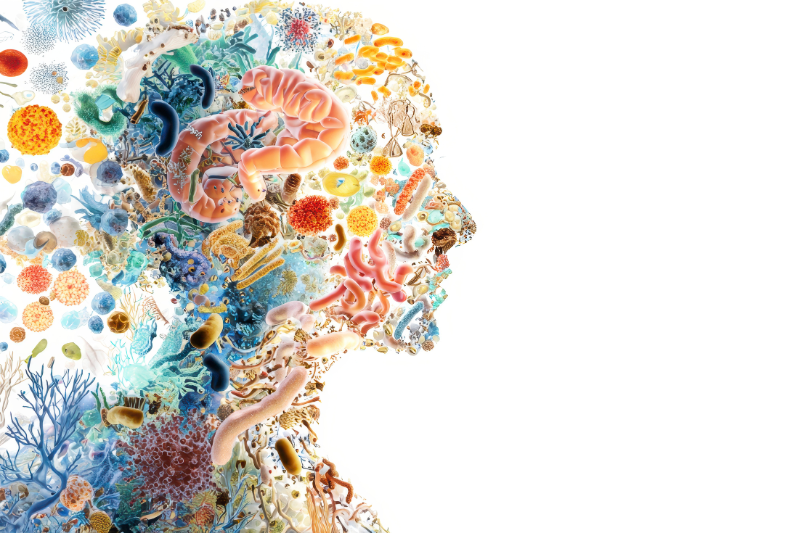
But the really big one that we focus on now is the human gut microbiome, because that actually affects all those other things. So 70% of our immune system is really in our gut, and the gut microbes, their main role is to digest the bits of food that our human enzymes can’t digest, and that’s primarily complex carbohydrate fibre, different types of fibres, but also things like polyphenols you would have heard of. And when they do that, they produce thousands of molecules. And these molecules, they influence the way our genes express themselves. They very powerfully influence our immune system. The level of serotonin in the brain is influenced by how the gut breaks down tryptophan, for example. So the gut is very, very quickly affected by what we eat, and in turn it very quickly affects our physiology from top to toe.
Preeya Alexander: It’s so fascinating, isn’t it, how complex it all is. What more do we need to find out?
Felice Jacka: Look, you know, with science you can go forever and you can dig very deeply. What I’m very, very focused on now is how planetary health interacts with human health via the microbes. Because the microbes in the soil are a very important aspect of nutrition in food. So when you have microbially really active soil, you get vegetables and plants that are much higher in nutrient density and much higher in what is known as nutritional dark matter. So these are the phytochemicals. Now, we know about 8,000 of them. This is like the polyphenols, flavanols, people know them as antioxidants, but there may be as many as 150,000 of these, and we don’t know what they do, how they interact with receptors in our body. And then you’ve got, of course, macro- and micronutrients, all together in the complex package of a food matrix. And this is why you don’t want ultra-processed foods, because they don’t have any of that complexity.
But I do want to just say one thing, so we don’t run out of time. If you look at all the observational evidence around the world, so that’s not experiments, it’s just looking at what people eat, taking into account things like their socioeconomic circumstances, and, you know, all sorts of other things. And look at the risk for depression, we see that it’s reduced in people who have better quality diets with more whole foods and less of those ultra-processed foods. This is completely independent of body weight, and this is the big issue around food for the last 20 or so years, is it all focuses on obesity, as if body weight equals health and it’s the only thing that matters. Now, this is actually not true. We need to stop thinking about the way people look and focus much more on how we nurture ourselves, how we feed our body, our brain, our gut, to be happy and healthy and have a wonderful relationship with beautiful, real, local food.
Preeya Alexander: That was Felice Jacka, who is a Distinguished Professor of Nutritional Psychiatry and founder and director of the Food and Mood Centre, and Dr Tetyana Rocks, who’s the lead of the Food and Mood Academy.
link

:max_bytes(150000):strip_icc()/GettyImages-1644727881-73ef3c9679a6447faafc74eb0ff22f1e.jpg "6 Fish That Offer the Most Benefits for Your Heart and Brain")







+ There are no comments
Add yours