
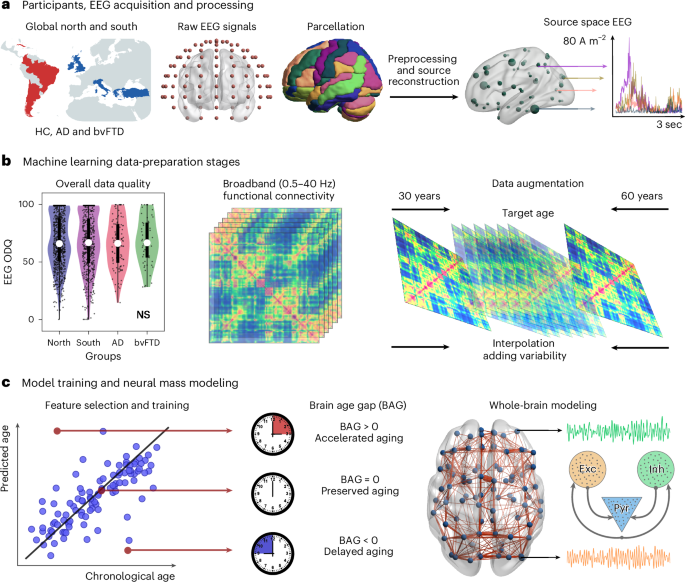
Moguilner, S. et al. Brain clocks capture diversity and disparities in aging and dementia across geographically diverse populations. Nat. Med. 30, 3646–3657 (2024).
Google Scholar
Tian, Y. E. et al. Heterogeneous aging across multiple organ systems and prediction of chronic disease and mortality. Nat. Med. 29, 1221–1231 (2023).
Google Scholar
Jones, D. T., Lee, J. & Topol, E. J. Digitising brain age. Lancet 400, 988–988 (2022).
Google Scholar
Cole, J. H. & Franke, K. Predicting age using neuroimaging: innovative brain ageing biomarkers. Trends Neurosci. 40, 681–690 (2017).
Google Scholar
Bashyam, V. M. et al. MRI signatures of brain age and disease over the lifespan based on a deep brain network and 14,468 individuals worldwide. Brain 143, 2312–2324 (2020).
Google Scholar
Hou, Y. et al. Ageing as a risk factor for neurodegenerative disease. Nat. Rev. Neurol. 15, 565–581 (2019).
Google Scholar
Legaz, A. et al. Structural inequality linked to brain volume and network dynamics in aging and dementia across the Americas. Nat. Aging 5, 259–274 (2024).
Google Scholar
Scheltens, P. et al. Alzheimer’s disease. Lancet 388, 505–517 (2016).
Google Scholar
Tseng, W.-Y. I., Hsu, Y.-C. & Kao, T.-W. Brain age difference at baseline predicts clinical dementia rating change in approximately two years. J. Alzheimers Dis. 86, 613–627 (2022).
Google Scholar
Prado, P. et al. The BrainLat project, a multimodal neuroimaging dataset of neurodegeneration from underrepresented backgrounds. Sci. Data 10, 889 (2023).
Google Scholar
Baez, S., Alladi, S. & Ibanez, A. Global South research is critical for understanding brain health, ageing and dementia. Clin. Transl. Med. 13, e1486 (2023).
Google Scholar
Greene, A. S. et al. Brain–phenotype models fail for individuals who defy sample stereotypes. Nature 609, 109–118 (2022).
Google Scholar
Marek, S. et al. Reproducible brain-wide association studies require thousands of individuals. Nature 603, 654–660 (2022).
Google Scholar
Lewandowska, P. et al. Association between real-time strategy video game learning outcomes and pre-training brain white matter structure: preliminary study. Sci. Rep. 12, 20741 (2022).
Google Scholar
Ranasinghe, K. G. et al. Altered excitatory and inhibitory neuronal subpopulation parameters are distinctly associated with tau and amyloid in Alzheimer’s disease. eLife 11, e77850 (2022).
Google Scholar
Ibanez, A., Kringelbach, M. L. & Deco, G. A synergetic turn in cognitive neuroscience of brain diseases. Trends Cogn. Sci. (2024).
Google Scholar
Santamaria-Garcia, H. et al. Factors associated with healthy aging in Latin American populations. Nat. Med. 29, 2248–2258 (2023).
Google Scholar
Parra, M. A. et al. Dementia in Latin America. Neurology 90, 222–231 (2018).
Google Scholar
McGlinchey, E. et al. Biomarkers of neurodegeneration across the Global South. Lancet Healthy Longev 5, 100616 (2024).
Google Scholar
Lotze, M. et al. Income is associated with hippocampal/amygdala and education with cingulate cortex grey matter volume. Sci. Rep. 10, 18786 (2020).
Google Scholar
De Looze, C. et al. Examining the impact of socioeconomic position across the life course on cognitive function and brain structure in healthy aging. J. Gerontol. A 78, 890–901 (2023).
Google Scholar
Yaple, Z. A. & Yu, R. Functional and structural brain correlates of socioeconomic status. Cerebral Cortex 30, 181–196 (2020).
Google Scholar
Wang, A. Y. et al. Socioeconomic status and risks of cognitive impairment and dementia: a systematic review and meta-analysis of 39 prospective studies. J. Prevent. Alzheimers Dis 10, 83–94 (2023).
Google Scholar
Migeot, J., Calivar, M., Granchetti, H., Ibáñez, A. & Fittipaldi, S. Socioeconomic status impacts cognitive and socioemotional processes in healthy ageing. Sci. Rep. 12, 6048 (2022).
Google Scholar
Hatzenbuehler, M. L., McLaughlin, K. A., Weissman, D. G. & Cikara, M. A research agenda for understanding how social inequality is linked to brain structure and function. Nat. Hum. Behav. 8, 20–31 (2024).
Google Scholar
Ibáñez, A., Legaz, A. & Ruiz-Adame, M. Addressing the gaps between socioeconomic disparities and biological models of dementia. Brain 146, 3561–3564 (2023).
Google Scholar
Parra-Rodriguez, M. A. et al. The EuroLaD‐EEG consortium: towards a global EEG platform for dementia, for seeking to reduce the regional impact of dementia. Alzheimers Dement. 18, e059944 (2022).
Google Scholar
Ribeiro, F., Teixeira-Santos, A. C., Caramelli, P. & Leist, A. K. Prevalence of dementia in Latin America and Caribbean countries: systematic review and meta-analyses exploring age, sex, rurality and education as possible determinants. Ageing Res. Rev. 81, 101703 (2022).
Google Scholar
Vega, I. E., Cabrera, L. Y., Wygant, C. M., Velez-Ortiz, D. & Counts, S. E. Alzheimer’s disease in the Latino community: intersection of genetics and social determinants of health. J. Alzheimers Dis. 58, 979–992 (2017).
Google Scholar
Gatica, M. et al. High-order functional redundancy in ageing explained via alterations in the connectome in a whole-brain model. PLoS Comput. Biol. 18, e1010431 (2022).
Google Scholar
Deco, G. & Kringelbach, M. L. Great expectations: using whole-brain computational connectomics for understanding neuropsychiatric disorders. Neuron 84, 892–905 (2014).
Google Scholar
Lynn, C. W. & Bassett, D. S. The physics of brain network structure, function and control. Nat. Rev. Phys. 1, 318–332 (2019).
Google Scholar
Coronel-Oliveros, C., Gießing, C., Medel, V., Cofré, R. & Orio, P. Whole-brain modeling explains the context-dependent effects of cholinergic neuromodulation. NeuroImage 265, 119782 (2023).
Google Scholar
Gatica, M. et al. High-order interdependencies in the aging brain. Brain Connect. 11, 734–744 (2021).
Google Scholar
Prado, P. et al. Dementia ConnEEGtome: towards multicentric harmonization of EEG connectivity in neurodegeneration. Int. J. Psychophysiol. 172, 24–38 (2022).
Google Scholar
Alber, M. et al. Integrating machine learning and multiscale modeling—perspectives, challenges and opportunities in the biological, biomedical and behavioral sciences. npj Digit. Med. 2, 115 (2019).
Google Scholar
Al Zoubi, O. et al. Predicting age from brain EEG signals—a machine learning approach. Front. Aging Neurosci 10, 184 (2018).
Google Scholar
Khayretdinova, M. et al. Predicting age from resting-state scalp EEG signals with deep convolutional neural networks on TD-brain dataset. Front. Aging Neurosci 14, 1019869 (2022).
Google Scholar
Signorino, M., Pucci, E., Belardinelli, N., Nolfe, G. & Angeleri, F. EEG spectral analysis in vascular and Alzheimer dementia. Electroencephalogr. Clin. Neurophysiol. 94, 313–325 (1995).
Google Scholar
Besthorn, C. et al. Discrimination of Alzheimer’s disease and normal aging by EEG data. Electroencephalogr. Clin. Neurophysiol. 103, 241–248 (1997).
Google Scholar
Stefanovski, L. et al. Linking molecular pathways and large-scale computational modeling to assess candidate disease mechanisms and pharmacodynamics in Alzheimer’s disease. Front. Comput. Neurosci 13, 54 (2019).
Google Scholar
Coronel‐Oliveros, C. et al. Viscous dynamics associated with hypoexcitation and structural disintegration in neurodegeneration via generative whole‐brain modeling. Alzheimers Dement. (2024).
Google Scholar
Maestú, F., de Haan, W., Busche, M. A. & DeFelipe, J. Neuronal excitation/inhibition imbalance: core element of a translational perspective on Alzheimer pathophysiology. Ageing Res. Rev. 69, 101372 (2021).
Google Scholar
Lopatina, O. L. et al. Excitation/inhibition imbalance and impaired neurogenesis in neurodevelopmental and neurodegenerative disorders. Rev. Neurosci. 30, 807–820 (2019).
Google Scholar
Martínez‐Cañada, P., Perez‐Valero, E., Minguillon, J., Pelayo, F., López Gordo, M. A. & Morillas, C. Combining aperiodic 1/f slopes and brain simulation: an EEG/MEG proxy marker of excitation/inhibition imbalance in Alzheimer’s disease. Alzheimers Dement. 15, e12477 (2023).
van den Heuvel, M. P. & Sporns, O. Network hubs in the human brain. Trends Cogn. Sci. 17, 683–696 (2013).
Google Scholar
van den Heuvel, M. P. & Sporns, O. Rich-club organization of the human connectome. J. Neurosci. 31, 15775–15786 (2011).
Google Scholar
Coronel-Oliveros, C., Castro, S., Cofré, R. & Orio, P. Structural features of the human connectome that facilitate the switching of brain dynamics via noradrenergic neuromodulation. Front. Comput. Neurosci. (2021).
Deco, G., Van Hartevelt, T. J., Fernandes, H. M., Stevner, A. & Kringelbach, M. L. The most relevant human brain regions for functional connectivity: evidence for a dynamical workspace of binding nodes from whole-brain computational modelling. NeuroImage 146, 197–210 (2017).
Google Scholar
Dai, Z. et al. Identifying and mapping connectivity patterns of brain network hubs in Alzheimer’s disease. Cerebral Cortex 25, 3723–3742 (2015).
Google Scholar
Cohen, J. R. & D’Esposito, M. The segregation and integration of distinct brain networks and their relationship to cognition. J. Neurosci. 36, 12083–12094 (2016).
Google Scholar
Lord, L.-D., Stevner, A. B., Deco, G. & Kringelbach, M. L. Understanding principles of integration and segregation using whole-brain computational connectomics: implications for neuropsychiatric disorders. Phil. Trans. R. Soc. A 375, 20160283 (2017).
Moguilner, S. et al. Biophysical models applied to dementia patients reveal links between geographical origin, gender, disease duration and loss of neural inhibition. Alzheimers Res. Ther. 16, 79 (2024).
Google Scholar
Amato, L. G. et al. Personalized modeling of Alzheimer’s disease progression estimates neurodegeneration severity from EEG recordings. Alzheimers Dement. 16, e12526 (2024).
Snyder, H. M. et al. Sex biology contributions to vulnerability to Alzheimer’s disease: a think tank convened by the Women’s Alzheimer’s Research Initiative. Alzheimers Dement. 12, 1186–1196 (2016).
Google Scholar
de Boer, S. C. M. et al. Differences in sex distribution between genetic and sporadic frontotemporal dementia. J. Alzheimers Dis. 84, 1153–1161 (2021).
Google Scholar
Fisher, D. W., Bennett, D. A. & Dong, H. Sexual dimorphism in predisposition to Alzheimer’s disease. Neurobiol. Aging 70, 308–324 (2018).
Google Scholar
Ganaie, M. A., Tanveer, M. & Beheshti, I. Brain age prediction with improved least squares twin SVR. IEEE J. Biomed. Health Inform. 27, 1661–1669 (2023).
Google Scholar
Birba, A. et al. Allostatic-interoceptive overload in frontotemporal dementia. Biol. Psychiatry 92, 54–67 (2022).
Google Scholar
Migeot, J. A., Duran-Aniotz, C. A., Signorelli, C. M., Piguet, O. & Ibáñez, A. A predictive coding framework of allostatic-interoceptive overload in frontotemporal dementia. Trends Neurosci. 45, 838–853 (2022).
Google Scholar
Abdel-Naseer, M. Epidemiology of dementia in developing countries. J. Neurol. Sci. 405, 72–73 (2019).
Google Scholar
Ibañez, A. & Manes, F. Contextual social cognition and the behavioral variant of frontotemporal dementia. Neurology 78, 1354–1362 (2012).
Google Scholar
Pandics, T. et al. Exposome and unhealthy aging: environmental drivers from air pollution to occupational exposures. GeroScience 45, 3381–3408 (2023).
Google Scholar
Finch, C. E. & Kulminski, A. M. The Alzheimer’s disease exposome. Alzheimers Dement. 15, 1123–1132 (2019).
Google Scholar
Risk factors related to population diversity and disparity determine healthy aging. Nat. Med. 29, 2183–2184 (2023).
Griffa, A. & Van den Heuvel, M. P. Rich-club neurocircuitry: function, evolution and vulnerability. Dialogues Clin. Neurosci. 20, 121–132 (2018).
Google Scholar
Chenot, Q., Lepron, E., De Boissezon, X. & Scannella, S. Functional connectivity within the fronto-parietal network predicts complex task performance: a fNIRS study. Front. Neuroergonomics 2, 718176 (2021).
Google Scholar
Ptak, R. The frontoparietal attention network of the human brain. Neuroscientist 18, 502–515 (2012).
Google Scholar
Küchenhoff, S. et al. Visual processing speed is linked to functional connectivity between right frontoparietal and visual networks. Eur. J. Neurosci. 53, 3362–3377 (2021).
Google Scholar
Kim, Y. H. et al. Real-time strategy video game experience and visual perceptual learning. J. Neurosci. 35, 10485–10492 (2015).
Google Scholar
Campbell, K. L., Grady, C. L., Ng, C. & Hasher, L. Age differences in the frontoparietal cognitive control network: implications for distractibility. Neuropsychologia 50, 2212–2223 (2012).
Google Scholar
Xia, H., He, Q. & Chen, A. Understanding cognitive control in aging: a brain network perspective. Front. Aging Neurosci 14, 1038756 (2022).
Google Scholar
Musa, G. et al. Alzheimer’s disease or behavioral variant frontotemporal dementia? Review of key points toward an accurate clinical and neuropsychological diagnosis. J. Alzheimers Dis. 73, 833–848 (2020).
Google Scholar
Boroshok, A. L. et al. Individual differences in frontoparietal plasticity in humans. npj Sci. Learn. 7, 14 (2022).
Google Scholar
Berry, K. P. & Nedivi, E. Experience-dependent structural plasticity in the visual system. Annu. Rev. Vis. Sci. 2, 17–35 (2016).
Google Scholar
Nikolaidis, A., Voss, M. W., Lee, H., Vo, L. T. K. & Kramer, A. F. Parietal plasticity after training with a complex video game is associated with individual differences in improvements in an untrained working memory task. Front. Hum. Neurosci 8, 169 (2014).
Google Scholar
Schmidt, S. et al. Experience-dependent structural plasticity in the adult brain: how the learning brain grows. NeuroImage 225, 117502 (2021).
Google Scholar
Kowalczyk, N. et al. Real‐time strategy video game experience and structural connectivity–a diffusion tensor imaging study. Hum. Brain Mapp. 39, 3742–3758 (2018).
Google Scholar
Toepper, M. Dissociating normal aging from Alzheimer’s disease: a view from cognitive neuroscience. J. Alzheimers Dis. 57, 331–352 (2017).
Google Scholar
Illán‐Gala, I. et al. Sex differences in the behavioral variant of frontotemporal dementia: a new window to executive and behavioral reserve. Alzheimers Dement. 17, 1329–1341 (2021).
Google Scholar
Moore, K. M. et al. Age at symptom onset and death and disease duration in genetic frontotemporal dementia: an international retrospective cohort study. Lancet Neurol. 19, 145–156 (2020).
Google Scholar
Perry, D. C. et al. Clinicopathological correlations in behavioural variant frontotemporal dementia. Brain 140, 3329–3345 (2017).
Google Scholar
Pini, L. et al. Brain atrophy in Alzheimer’s disease and aging. Ageing Res. Rev. 30, 25–48 (2016).
Google Scholar
Gili, T. et al. Regional brain atrophy and functional disconnection across Alzheimer’s disease evolution. J. Neurol. Neurosurg. Psychiatry 82, 58–66 (2011).
Google Scholar
La Joie, R. et al. Region-specific hierarchy between atrophy, hypometabolism and β-amyloid (Aβ) load in Alzheimer’s disease dementia. J. Neurosci. 32, 16265–16273 (2012).
Google Scholar
Klupp, E. et al. Prefrontal hypometabolism in Alzheimer disease is related to longitudinal amyloid accumulation in remote brain regions. J. Nucl. Med. 56, 399–404 (2015).
Google Scholar
Förster, S. et al. Regional expansion of hypometabolism in Alzheimer’s disease follows amyloid deposition with temporal delay. Biol. Psychiatry 71, 792–797 (2012).
Google Scholar
Herman, J. P., Nawreen, N., Smail, M. A. & Cotella, E. M. Brain mechanisms of HPA axis regulation: neurocircuitry and feedback in context Richard Kvetnansky lecture. Stress 23, 617–632 (2020).
Google Scholar
Dedovic, K., Duchesne, A., Andrews, J., Engert, V. & Pruessner, J. C. The brain and the stress axis: the neural correlates of cortisol regulation in response to stress. NeuroImage 47, 864–871 (2009).
Google Scholar
Kelberman, M. A. et al. Consequences of hyperphosphorylated tau in the locus coeruleus on behavior and cognition in a rat model of Alzheimer’s disease. J. Alzheimers Dis. 86, 1037–1059 (2022).
Google Scholar
Kelberman, M. A. et al. Age-dependent dysregulation of locus coeruleus firing in a transgenic rat model of Alzheimer’s disease. Neurobiol. Aging 125, 98–108 (2023).
Google Scholar
Corriveau-Lecavalier, N., Mellah, S., Clément, F. & Belleville, S. Evidence of parietal hyperactivation in individuals with mild cognitive impairment who progressed to dementia: a longitudinal fMRI study. NeuroImage Clin. 24, 101958 (2019).
Google Scholar
Arbabyazd, L. et al. Virtual connectomic datasets in Alzheimer’s disease and aging using whole-brain network dynamics modelling. eNeuro (2021).
Sanz Perl, Y. et al. Model-based whole-brain perturbational landscape of neurodegenerative diseases. eLife 12, e83970 (2023).
Google Scholar
Ipiña, I. P. et al. Modeling regional changes in dynamic stability during sleep and wakefulness. NeuroImage 215, 116833 (2020).
Google Scholar
Sanz Perl, Y. et al. Perturbations in dynamical models of whole-brain activity dissociate between the level and stability of consciousness. PLoS Comput. Biol. 17, e1009139 (2021).
Google Scholar
Woodard, J. L. & Sugarman, M. A. in Behavioral Neurobiology of Aging 113–136 (Springer, 2011).
Fujita, S. et al. Characterization of brain volume changes in aging individuals with normal cognition using serial magnetic resonance imaging. JAMA Netw. Open 6, e2318153 (2023).
Google Scholar
Ibañez, A. et al. Predicting and characterizing neurodegenerative subtypes with multimodal neurocognitive signatures of social and cognitive processes. J. Alzheimers Dis. 83, 227–248 (2021).
Google Scholar
Walhovd, K. B. et al. Education and income show heterogeneous relationships to lifespan brain and cognitive differences across European and US cohorts. Cerebral Cortex 32, 839–854 (2022).
Google Scholar
Hunt, J. F. V. et al. Association of neighborhood-level disadvantage with cerebral and hippocampal volume. JAMA Neurol. 77, 451–460 (2020).
Google Scholar
Hernandez, H. et al. Brain health in diverse settings: how age, demographics and cognition shape brain function. NeuroImage 295, 120636 (2024).
Google Scholar
Marek, S. & Laumann, T. O. Replicability and generalizability in population psychiatric neuroimaging. Neuropsychopharmacology 50, 52–57 (2024).
Google Scholar
Ibanez, A. et al. The multi-partner consortium to expand dementia research in Latin America (ReDLat): driving multicentric research and implementation science. Front. Neurol 12, 631722 (2021).
Google Scholar
McKhann, G. M. et al. The diagnosis of dementia due to Alzheimer’s disease: recommendations from the National Institute on Aging‐Alzheimer’s Association workgroups on diagnostic guidelines for Alzheimer’s disease. Alzheimers Dement. 7, 263–269 (2011).
Google Scholar
Dubois, B. et al. Research criteria for the diagnosis of Alzheimer’s disease: revising the NINCDS–ADRDA criteria. Lancet Neurol. 6, 734–746 (2007).
Google Scholar
Rascovsky, K. et al. Sensitivity of revised diagnostic criteria for the behavioural variant of frontotemporal dementia. Brain 134, 2456–2477 (2011).
Google Scholar
Hu, S., Lai, Y., Valdes-Sosa, P. A., Bringas-Vega, M. L. & Yao, D. How do reference montage and electrodes setup affect the measured scalp EEG potentials? J. Neural Eng. 15, 026013 (2018).
Google Scholar
Delorme, A. & Makeig, S. EEGLAB: an open source toolbox for analysis of single-trial EEG dynamics including independent component analysis. J. Neurosci. Methods 134, 9–21 (2004).
Google Scholar
Pion-Tonachini, L., Kreutz-Delgado, K. & Makeig, S. ICLabel: an automated electroencephalographic independent component classifier, dataset and website. NeuroImage 198, 181–197 (2019).
Google Scholar
Zhao, L. et al. Quantitative signal quality assessment for large-scale continuous scalp electroencephalography from a big data perspective. Physiol. Meas. 44, 035009–035009 (2023).
Google Scholar
Grech, R. et al. Review on solving the inverse problem in EEG source analysis. J. NeuroEng. Rehabil. 5, 25 (2008).
Google Scholar
Tzourio-Mazoyer, N. et al. Automated anatomical labeling of activations in SPM using a macroscopic anatomical parcellation of the MNI MRI single-subject brain. NeuroImage 15, 273–289 (2002).
Google Scholar
Rommel, C., Paillard, J., Moreau, T. & Gramfort, A. Data augmentation for learning predictive models on EEG: a systematic comparison. J. Neural Eng. 19, 066020 (2022).
Google Scholar
He, C., Liu, J., Zhu, Y. & Du, W. Data augmentation for deep neural networks model in EEG classification task: a review. Front. Hum. Neurosci 15, 765525 (2021).
Google Scholar
Smith, S. M., Vidaurre, D., Alfaro-Almagro, F., Nichols, T. E. & Miller, K. L. Estimation of brain age delta from brain imaging. NeuroImage 200, 528–539 (2019).
Google Scholar
Chen, B. et al. Contrasting inequality in human exposure to greenspace between cities of Global North and Global South. Nat. Commun. 13, 4636 (2022).
Google Scholar
Gonzalez-Gomez, R. et al. Qualitative and quantitative educational disparities and brain signatures in healthy aging and dementia across global settings. eClinicalMedicine 82, 103187 (2025).
Google Scholar
Filmer, D., Rogers, H., Angrist, N. & Sabarwal, S. Learning-adjusted years of schooling (LAYS): defining a new macro measure of education. Econ. Educ. Rev. 77, 101971 (2020).
Google Scholar
David, O. & Friston, K. J. A neural mass model for MEG/EEG. NeuroImage 20, 1743–1755 (2003).
Google Scholar
Otero, M., Lea-Carnall, C., Prado, P., Escobar, M.-J. & El-Deredy, W. Modelling neural entrainment and its persistence: influence of frequency of stimulation and phase at the stimulus offset. Biomed. Phys. Eng. Express (2022).
Google Scholar
Jansen, B. H. & Rit, V. G. Electroencephalogram and visual evoked potential generation in a mathematical model of coupled cortical columns. Biol. Cybern. 73, 357–366 (1995).
Google Scholar
Gilbert, C. D., Hirsch, J. A. & Wiesel, T. N. Lateral interactions in visual cortex. Cold Spring Harb. Symp. Quant. Biol. 55, 663–677 (1990).
Google Scholar
McGuire, B. A., Gilbert, C. D., Rivlin, P. K. & Wiesel, T. N. Targets of horizontal connections in macaque primary visual cortex. J. Comp. Neurol. 305, 370–392 (1991).
Google Scholar
Abeysuriya, R. G. et al. A biophysical model of dynamic balancing of excitation and inhibition in fast oscillatory large-scale networks. PLoS Comput. Biol. 14, e1006007 (2018).
Google Scholar
Gütig, R., Aharonov, R., Rotter, S. & Sompolinsky, H. Learning input correlations through nonlinear temporally asymmetric Hebbian plasticity. J. Neurosci. 23, 3697–3714 (2003).
Google Scholar
Ito, T. et al. Task-evoked activity quenches neural correlations and variability across cortical areas. PLoS Comput. Biol. 16, e1007983 (2020).
Google Scholar
Wang, Z., Bovik, A. C., Sheikh, H. R. & Simoncelli, E. P. Image quality assessment: from error visibility to structural similarity. IEEE Trans. Image Process. 13, 600–612 (2004).
Google Scholar
Medel, V., Irani, M., Crossley, N., Ossandón, T. & Boncompte, G. Complexity and 1/f slope jointly reflect brain states. Sci. Rep. 13, 21700 (2023).
Daianu, M. et al. Disrupted rich club network in behavioral variant frontotemporal dementia and early-onset Alzheimer’s disease. Hum. Brain Mapp. 37, 868–883 (2016).
Google Scholar
de Haan, W., Mott, K., van Straaten, E. C. W., Scheltens, P. & Stam, C. J. Activity dependent degeneration explains hub vulnerability in Alzheimer’s disease. PLoS Comput. Biol. 8, e1002582 (2012).
Google Scholar
Kizilirmak, J. M., Soch, J., Richter, A. & Schott, B. H. Age-related differences in fMRI subsequent memory effects are directly linked to local grey matter volume differences. Neurobiol. Aging 134, 160–164 (2024).
Google Scholar
Rubinov, M. & Sporns, O. Complex network measures of brain connectivity: uses and interpretations. NeuroImage 52, 1059–1069 (2010).
Google Scholar
Lancichinetti, A. & Fortunato, S. Consensus clustering in complex networks. Sci. Rep. 2, 336 (2012).
Google Scholar
Newman, M. E. J. Modularity and community structure in networks. Proc. Natl Acad. Sci. USA 103, 8577–8582 (2006).
Google Scholar
Guimerà, R. & Nunes Amaral, L. A. Functional cartography of complex metabolic networks. Nature 433, 895–900 (2005).
Google Scholar
Hofmann, M. A. Searching for effects in big data: why p-values are not advised and what to use instead. In Proc. Winter Simulation Conference (eds Yilmaz, L. et al.) 725–736 (IEEE, 2015).
Benjamini, Y. & Hochberg, Y. Controlling the false discovery rate: a practical and powerful approach to multiple testing. J. R. Stat. Soc. B 57, 289–300 (1995).
Google Scholar
carlosmig/EEG-Dementias: EEG modeling in aging and dementia. Zenodo (2025).
Xia, M., Wang, J. & He, Y. BrainNet Viewer: a network visualization tool for human brain connectomics. PLoS ONE 8, e68910 (2013).
Google Scholar
link





:max_bytes(150000):strip_icc()/Health-GettyImages-1203392811-d7b532109ae648f29c53dd079b53f8ae.jpg "New Study Links 6 Artificial Sweeteners to Faster Cognitive Decline")



:max_bytes(150000):strip_icc()/GettyImages-1644727881-73ef3c9679a6447faafc74eb0ff22f1e.jpg "6 Fish That Offer the Most Benefits for Your Heart and Brain")
+ There are no comments
Add yours