
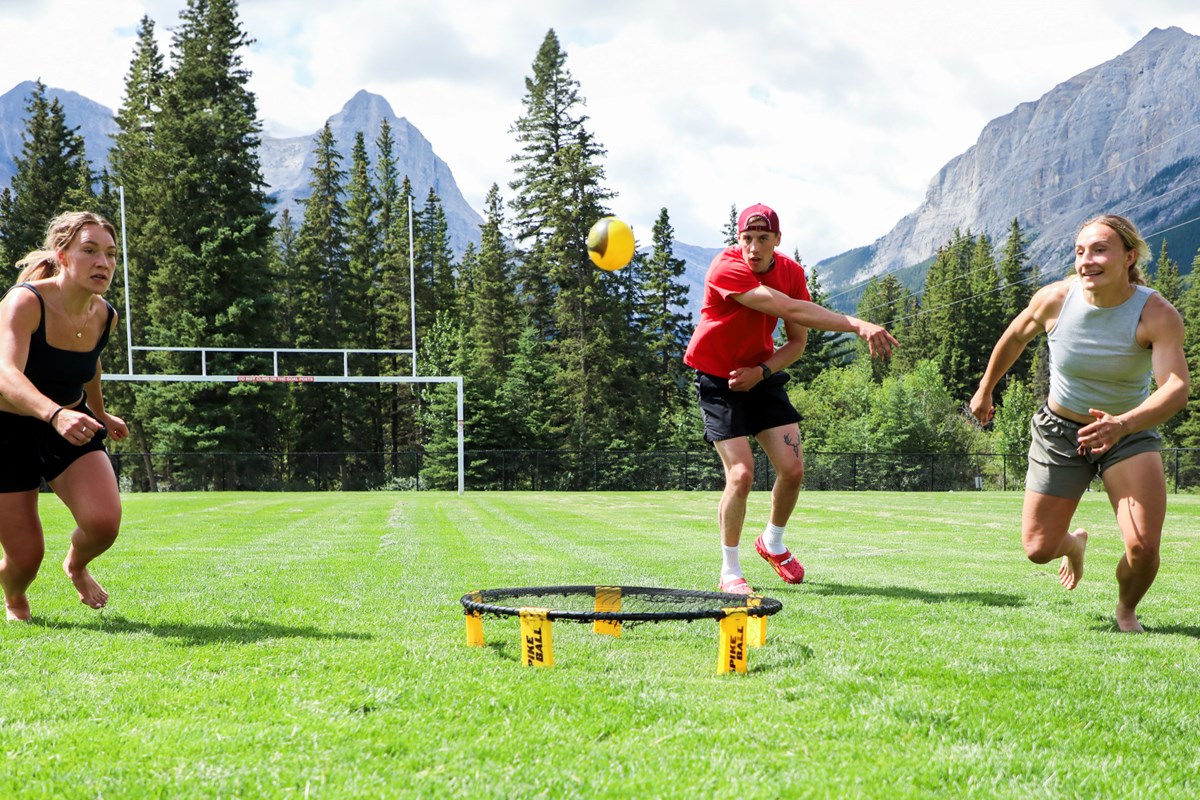
“It’s a good cause, it’s fun, it spreads awareness about mental health, brain health and just being physically healthy.”
CANMORE – Looking over the grassy field at Canmore Collegiate High School on Saturday (July 21), there was no shortage of athletic excellence, diving, sprinting and hitting the ball at a spikeball tournament.
Nathan Ellis was thrilled over the turnout, which doubled as a brain health fundraiser that has resonated with him for a lifetime.
The games went fast and furious in the two-on-two tournament with 21 teams, which players have to use agility, quick reflexes and athleticism. Aerobic Exercise is one of the six pillars of Brain Changes, a not-for-profit that funds research for traumatic brain injury rehabilitation, which is a reason Ellis chose to host a spikeball tournament for the Move For Neurogenesis fundraiser initiative.
“It’s a good cause, it’s fun, it spreads awareness about mental health, brain health and just being physically healthy,” said Ellis.
The local chapter lead for Brain Changes, Ellis was a forward with the Canmore Eagles, playing in 75 games during the 2021-22 and 2022-23 campaigns.
He left the team to pursue university, which is where he was first introduced to Brain Changes and its six pillars to positively change brain health: cognitive exercise, aerobic exercise, limiting harmful exposures, nutrition, sleep hygiene and mindfulness.
“It just kind of spoke to me with the fact I grew up playing hockey … but also seeing the effects of mild head trauma and concussions on one of my brothers, teammates, [and] myself throughout my hockey career,” said Ellis. “I realized it’s a lot more important than people think at the time and Brain Changes really pushes that on people and I really like that about them.”
Some of the spikeball players were pro-level and Olympic-level athletes from hockey, alpine skiing and rugby. One thing those sports all have in common is the possibility for head trauma.
All proceeds went toward research at Brain Changes.
Spiking in style
The Emerside Ballers – Jeremy Ahn and Bryan Kim – made quick work of the Ice Cats – Ellis and Sam Jones – in the final of the spikeball tournament, winning 2-0 in games.
Spikeball, or roundnet, requires a team to hit a ball three times before hitting it onto a small net, trying to make it difficult for the opposing team to return. Points are scored when the team can’t return to the ball, the ball hits the rim, or bounces more than once on the net.
The winning duo won all seven of their matches en route to finals, with hardly any team having much resistance to the dominant pair.
A hockey player originally from Banff, Ahn was happy to support Brain Changes.
“I think it’s a great initiative. I’m super happy to be out here and overall it’s just a great day,” Ahn said.
The match of the day was when the Ice Cats faced off against Kiki Alexander, a skier who made her World Cup debut last season, and Alberta Alpine’s Zuzana Rybarik.
A back-and-forth affair, the nearly one-hour long match ended with the slight edge going to the Ice Cats.
“That was so intense. That was literally why I’m exhausted from that game, that’s my excuse why we lost in the finals because that was so tiring,” Ellis said with a laugh.
Ellis thinks it could be an annual event in Canmore as the cause behind Move For Neurogenesis resonates with athletes in the community.
link









:max_bytes(150000):strip_icc()/GettyImages-1644727881-73ef3c9679a6447faafc74eb0ff22f1e.jpg "6 Fish That Offer the Most Benefits for Your Heart and Brain")
+ There are no comments
Add yours