
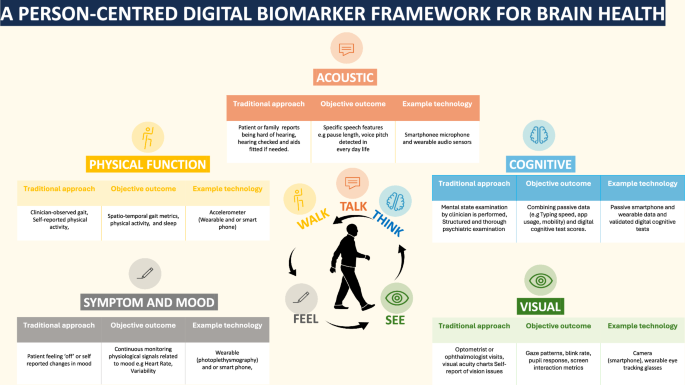
A fundamental limitation in current brain health assessments is the lack of widely used, scalable, disease-agnostic tools capable of evaluating cognitive, motor, emotional, and sensory functions simultaneously. Traditional methods are typically condition-specific, targeting isolated neurological diseases such as Alzheimer’s or Parkinson’s, and failing to capture the broader, lifelong trajectory of brain health. This siloed approach restricts our understanding and proactive management of brain health overlooking the dynamic and multidimensional interactions across different functional domains.
For example, cognitive assessments commonly employed in clinical trials for Alzheimer’s disease, including the Mini-Mental State Examination (MMSE) and the Alzheimer’s Disease Assessment Scale–Cognitive Subscale (ADAS-cog), predominantly focus on episodic memory. However, these can lack content validity and are restricted largely to episodic memory assessment, failing to measure executive function, attention, or other critical cognitive domains10. This can lead to more fragmented evaluation or siloed analysis, where different domains of brain function are considered separately, overlooking any potential interaction11. Additionally, current tools often lack sufficient sensitivity to detect subtle, pre-symptomatic changes, particularly in younger or healthy individuals3. The widespread use of wearables and mobile devices has provided an opportunity to augment by collecting real-world data across multiple functional domains as a proxy for brain health capital1.
Moving away from Subjective Self-Reported Approaches
Many current brain health assessments rely heavily on subjective self-reporting and clinician-administered tests, which can introduce significant variability and bias. Factors such as mood, motivation, and environmental conditions can influence results, leading to inconsistencies in cognitive test outcomes. For example, performance on widely used assessments like the Montreal Cognitive Assessment (MoCA) can be affected by factors such as anxiety, fatigue, or recent sleep quality, reducing the reliability of these measures12,13. These subjective, time-bound methods may be less sensitive in measuring gradual or long-term changes in brain function, which could be crucial for early detection of cognitive decline. Thus, preserving brain health capital requires objective, continuous, real-time monitoring methods, such as digital biomarkers, to complement traditional approaches and provide reliable, longitudinal insights into brain function7.
Objective assessment across the life course
While advanced neuroimaging techniques such as MRI, PET scans, and EEGs provide detailed insights into brain structure and activity, they can be cost-prohibitive, resource-intensive, and not always practical for routine monitoring across populations. These imaging methods typically provide only single, time-bound “snapshots,” making it challenging to detect subtle or early-stage changes crucial for proactive brain health management. In response, there is increasing interest in more portable, affordable, and accessible approaches, such as digital health technologies and sensors. These technologies offer the potential for continuous, real-world monitoring, capturing more subtle and dynamic shifts in brain function that might otherwise not be measured by existing approaches8.
link












:max_bytes(150000):strip_icc()/GettyImages-1644727881-73ef3c9679a6447faafc74eb0ff22f1e.jpg "6 Fish That Offer the Most Benefits for Your Heart and Brain")
+ There are no comments
Add yours