
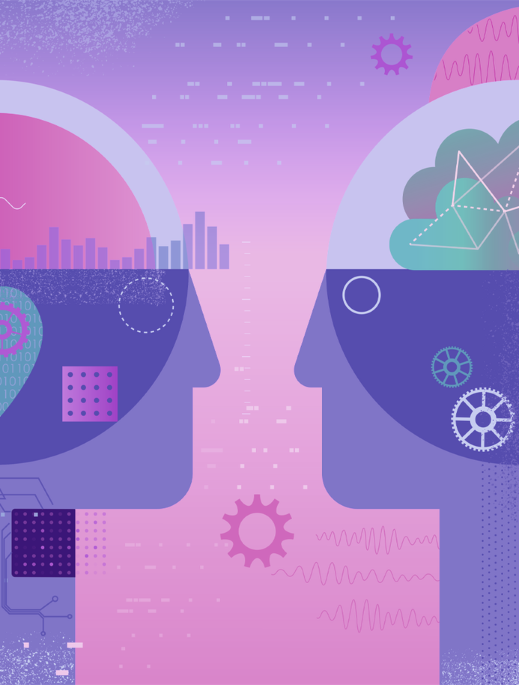
Digital twins — dynamically updated digital models of an individual’s physical, cognitive and/or emotional state — represent an intriguing and potentially transformative pathway for mental health and brain health. These precision tools promise to deliver insights that are continuous rather than episodic, personalized rather than generic and preventive rather than reactive.
The term ‘digital twin’, perhaps surprisingly, originates not from science fiction comic books but instead from many decades of aerospace programming development, much of it terrestrial, but not without its own drama. In April of 1970, Apollo 13 should have been the third attempt to survey and sample the Moon’s surface, but it was a mission immediately beset with technological failures and accidents. Pressure sensor faults impaired hardware and the guidance system, and an explosion of one of the oxygen tanks cut electrical power and water, incapacitating the craft and prompting the famous and oft-misquoted line to Mission Control, “Houston, we’ve had a problem.”

Credit: DrAfter123 / DigitalVision Vectors / Getty
On the ground, teams scrambled to resolve the barrage of technical issues that could leave the crew stranded. The crucial determinant of their success was the use of what was, in essence, a digital twin of Apollo 13: 15 functional simulators connected by a computer network, which allowed NASA engineers and astronauts to collaboratively test simulated scenarios under conditions of failure. Extensive training with this digital twin technology enabled the teams to devise multiple life-saving workarounds and to safely return the craft and crew to earth — proof of principle of the utility of data-informed linkages between simulated, digital representations and their associated real-world physical entities.
The conceptual fine-tuning of digital twin technology has tracked closely with broader technological and computing advances. Michael Grieves, a computer engineer and product-lifecycle-management expert, defined digital twins for manufacturing engineering in the early 2000s. Since then, the digital twin concept has been swiftly adapted in bioengineering and healthcare. A cursory glance at some of the most recent publications on digital twin applications in healthcare indicates the breadth of this paradigm, from cardiac electrophysiology, chronic pain and molecular radiotherapy to knee biomechanics. Fundamental to all of the digital twin uses for health is the idea that the methodology of integrating multimodal data inputs that are dynamically synthesized can produce a virtual model that enhances clinically useful information, whether by improving diagnostic specificity, guiding treatment selection or monitoring outcomes.
Digital twin technology for mental health and brain health is an appealing approach, given the growing recognition that psychiatric and cognitive disorders can be both heterogeneous and dynamic. Conditions such as depression, schizophrenia, mild cognitive impairment and dementia all involve fluctuating impairments across multiple domains of cognition, emotion and behavior. In contrast to standard interventions with static assessments and fixed intervals, digital twins offer a way to implement personalized interventions, monitor trajectories and anticipate changes as they occur or even before symptoms present.
In the October issue of Nature Mental Health, we feature a Comment on digital cognitive twins — a framework for generating a dynamic computational model of an individual’s cognitive state and biometric assessment that would inform personalized and integrated cognitive training. Mental health coaching apps delivered via smartphones, including those that target stress reduction or employ mindfulness-based programs, have proliferated in recent decades, as have computerized cognitive training programs intended to stave off age-related declines. Yet even interventions that have been demonstrated to be effective in clinical trials with limited follow-up seldom have the same effectiveness for real-world users. According to Murali Doraiswamy, the lead author of the Comment, “The Achilles’ heel of today’s health coaching apps is their low engagement and high attrition rates. Apps on the market today cannot tailor treatments well for a given individual.” The focus on tailoring is not a simply a selling point but a necessary feature: “Personalization matters, and meta-analyses suggest tailored interventions outperform static ones,” emphasizes author Jon Andoni Duñabeitia.
The Comment underscores several areas that are crucial to the successful uptake of digital cognitive twins, including the need for robust and validated methodology, which will probably go beyond conventional randomized controlled designs and instead require the development of more-responsive approaches, such as embedded micro-randomized trials and just-in-time adaptive interventions. Because digital cognitive twins inherently involve sensitive mental health and brain health data, there is an overarching need to adhere to safety and ethical ‘maps’ from the outset. Other recommendations include incorporating federated learning approaches that preserve privacy, employing dynamic consenting mechanisms for users and maintaining accountability through explainable artificial intelligence models. While policymakers must consider society-level consequences and safeguards around the use of artificial intelligence, researchers need to incorporate programmatic inclusivity and equitable access to tools and digital infrastructure.
The issue also contains a prime example of foundational and complementary work that may inform digital twin prediction paradigms. In an Article by Carlos Coronel-Oliveros, Augustin Ibanez and colleagues, the authors use biophysical modeling to inform ‘brain clock’ models that assess the deviations from healthy brain-aging trajectories, or so-called brain-age gaps between chronological brain age and predicted brain age. Their study uses electroencephalography data and functional magnetic resonance imaging, reflecting underlying mechanisms of neural patterns and connectivity between regions. Together with individual-level health data, such as genetic and lifestyle factors, collected from healthy participants and those along the dementia and Alzheimer disease continuum around the world, machine learning models allowed the authors to investigate the role of diversity in brain-age gaps. This work importantly reveals that socioeconomic inequalities, environmental exposure to pollution and sex are key predictors of accelerated brain aging. These are population-level findings, but they provide an additional framework for modeling an array of brain-based and demographic information that could shape future individual, personalized brain age assessment.
Integrating the dynamism of the brain with the quickly evolving digital landscape requires a constantly thoughtful approach. Anticipating where there is bias and risk to individuals, whether adverse events or privacy, is a paramount deliberation. The challenge now is to ensure that the promise of digital twins in mental health and brain health is realized and delivered responsibly — grounded in evidence, guided by ethics and accessible to all who stand to benefit.
link






:max_bytes(150000):strip_icc()/VWH-DI-Longevity-GutHealth-9dcf7e4e6b12452d9d1b3bb4dcfbd37b.jpg "Want to Boost Brain Health? Focus on Your Gut")


:max_bytes(150000):strip_icc()/GettyImages-1644727881-73ef3c9679a6447faafc74eb0ff22f1e.jpg "6 Fish That Offer the Most Benefits for Your Heart and Brain")
+ There are no comments
Add yours