
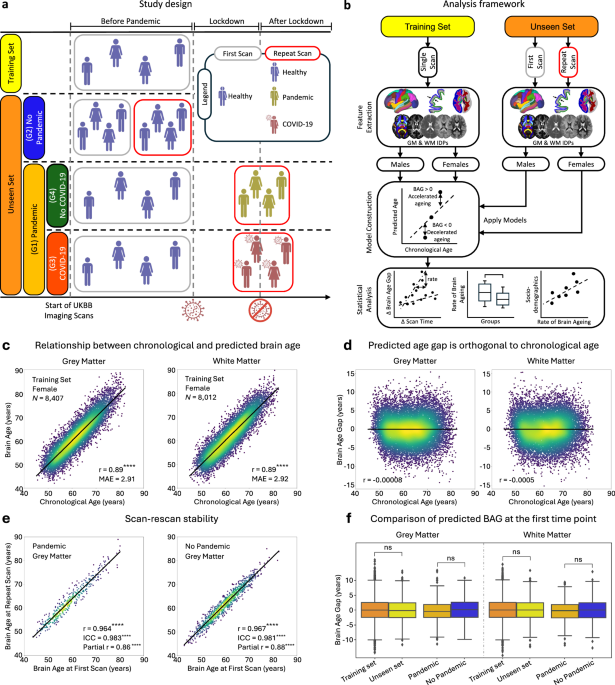
A brain age prediction model16 (Fig. 1a) was trained on MRI scans collected pre-March 2020 from 15,334 healthy middle-aged and older UKBB19 participants (‘training set’: 8407 female; age [mean ± SD]: 62.6 ± 7.6 years). From the full neuroimaging dataset of > 42,000 individuals, only participants classified as healthy, with no history of chronic disorders (e.g., heart disease, diabetes, dementia, kidney disease, major depression – see full list of exclusions in Supplementary Table 1 as in refs. 18,20) were included in this training set. This minimised the potential confounding effects of disease and comorbidities on brain age predictions. Hundreds of multi-modal IDPs were extracted21 and used as regressors in the model after PCA-based dimensionality reduction (Fig. 1b). As COVID-19 may affect differently WM and GM2,18,22,23 and susceptibility to neurological diseases can vary across sexes24, separate models were trained based on GM and WM features, and for males and females18.

a A brain age prediction model was trained using 20-fold cross-validation on healthy participants with a single pre-pandemic scan (training set). The model was applied to an unseen set comprising the Pandemic group (G1) and the No Pandemic group (G2). G1 was further subdivided into Pandemic–COVID-19 (G3) and Pandemic–No COVID-19 (G4). b Imaging-derived phenotypes (IDPs) were extracted from grey matter (GM) and white matter (WM) across scan times. Separate prediction models were trained by tissue type and sex using pre-pandemic data, and then applied independently to scans from different time points to estimate brain age gap (BAG). Statistical analyses assessed pandemic- and infection-related effects using longitudinal data. c Scatter plots show predicted vs. chronological age for GM and WM models in females (males shown in Supplementary Fig. 2). The diagonal line indicates perfect prediction. ‘N’ is the number of subjects used for training. Model performance was evaluated using Pearson’s correlation (r) and mean absolute error (MAE), averaged across 100 repetitions. d Relationship between BAG and chronological age for GM and WM models, aggregated across sexes. The black regression line indicates no age-related bias. e Predicted brain ages at two time points show high reproducibility in both groups (Pearson’s r > 0.96). Intraclass correlation coefficients were 0.981 (95% CI: 0.977–0.985) for the Pandemic group and 0.983 (95% CI: 0.980–0.985) for the No Pandemic group, confirming temporal stability. Partial correlation analyses, controlling for chronological age, yielded r = 0.86 (95% CI: 0.83–0.88) for the Pandemic group and r = 0.88 (95% CI: 0.87–0.90) for the No Pandemic group. f Boxplots compare BAG distributions between the training set (N = 15,334) and unseen (first scan) set (N = 996), and between Pandemic (N = 432) and No Pandemic (N = 564) groups for GM and WM models. No significant differences were observed (GM: p(FDR) = 0.44, 0.23; WM: p(FDR) = 0.99, 0.28). Each scatter point represents a participant. Asterisks (****) indicate FDR-corrected p ≤ 0.0001; ‘ns’ denotes non-significant differences.
These models were then applied to our unseen study cohort with two MRIs, comprising 996 healthy participants (552 female; age: 58.8 ± 6.2 years; mean inter-scan intervals (ΔT) of ~ 34 months – Supplementary Fig. 1), where participants with major chronic conditions before both scans were excluded to maintain consistency in health status across all subjects. The study cohort included the Pandemic group (G1: N = 432, 255 female) with one brain scan before and one after the pandemic, and the Control group (G2: N = 564, 297 female) with both scans before the pandemic. The groups were adjusted to be matched for age, sex, and other health markers (see Supplementary Table 2), and only participants with a minimum inter-scan interval of 2 years, who did not develop an interim health condition, were considered25 (Supplementary Fig. 1d). Using the trained models, brain age was estimated for both time points of each participant. The difference between estimated brain age and chronological age (BAG) was then obtained at both time points, and the rate of change in BAG was calculated and normalised for the inter-scan intervals as RBAG = (ΔBAG/ΔT).
Performance of brain age prediction models
Scatter plots in Fig. 1c depict the relationship between chronological and predicted brain age for each brain tissue type and sex (males shown in Supplementary Fig. 2). We employed an unbiased estimation approach for brain age16, ensuring BAG is orthogonal to chronological age. All models demonstrated relatively similar prediction accuracy, with Pearson’s r ranging from 0.905 (WM female model, p < 0.0001, 95% CI = 0.901–0.909; Mean Absolute Error (MAE) = 2.90 years) to 0.894 (WM male model, p < 0.0001, 95% CI = 0.890–0.899; MAE = 3.09 years), indicating that neuroimaging features captured a large proportion of chronological age variance, consistent with previous methodologically rigorous studies18,26.
We further confirmed that our model’s estimated brain age was unbiased towards the group mean27, and that participants’ age distribution was Gaussian16. For the remainder of this paper, unless otherwise stated, we aggregated the predicted brain age gap for male and female models across different brain tissue types and participant groups separately. Figure 1d shows that there was also no significant correlation between the estimated BAG and chronological age when applying the trained model to unseen data (Pearson’s r < 0.001). As expected, we found very high correlations between predicted brain ages of participants at the two time points (Fig. 1e, Pearson’s r > 0.96, FDR-corrected p < 4.0e-234), demonstrating high scan-rescan model reproducibility. The intraclass correlation coefficient (ICC) further supported this reproducibility, with an ICC of 0.981 (95% CI: 0.977–0.985) for the Pandemic group and 0.983 (95% CI: 0.980–0.985) for the No Pandemic group, indicating stability of estimated brain ages over time. In addition, partial correlation analysis, controlling for chronological age at each scan, yielded high partial correlations (Pandemic group: r = 0.86, 95% CI = [0.83–0.88], FDR-corrected p = 6.3e-120; No Pandemic group: r = 0.88, 95% CI = [0.87–0.90], FDR-corrected p = 6.5e-307). These results suggest that the reproducibility of brain age estimates reflects individual brain health properties.
No differences in mean predicted BAG was found between the training and unseen cohort’s first MRI data (Mann-Whitney two-sample t-test, GM: FDR-corrected p = 0.44, WM: FDR-corrected p = 0.99), demonstrating the model’s generalisability (Fig. 1f). Importantly, the estimated BAG for the first scan for the Pandemic group was not significantly different from the corresponding BAG for the Control (No Pandemic) group (GM: FDR-corrected p = 0.23, WM: FDR-corrected p = 0.28), confirming that our matching (Supplementary Table 2) effectively achieved comparable baseline BAGs.
Accelerated Brain ageing is associated with the COVID-19 pandemic, regardless of infection
Although BAGs were not statistically different between the Pandemic and Control groups at the first time point, the pandemic’s effect on brain ageing became evident with the second scan. Figure 2 presents the rates of change in BAG between the two scans (RBAG). The Pandemic group displayed significantly higher RBAG compared with the Controls (GM Cohen’s d = 0.606, WM Cohen’s d = 0.697; FDR-corrected p < 0.0001), indicating accelerated brain ageing.

This figure illustrates the distribution of the rate of change in brain age gap (BAG) across different brain tissue models and subject groups. The left panel corresponds to the Grey Matter (GM) model, while the right panel represents the White Matter (WM) model. Each group is displayed using coloured half-violin plots: orange for the Pandemic group (G1, N = 432), blue for the No Pandemic group (G2, N = 564), red for the Pandemic–COVID-19 group (G3, N = 134), and green for the Pandemic–No COVID-19 group (G4, N = 298). The y-axis indicates the rate of change in brain age gap in months per year. Pairwise comparisons between groups were performed using two-sample t tests, with p-values corrected for multiple comparisons using FDR. Cohen’s d values, which quantify the effect size of group differences, were also calculated.
To further investigate whether SARS-CoV-2 infection specifically influenced accelerated brain ageing, the Pandemic group was subdivided into: Pandemic–COVID-19 (G3), with participants who had COVID-19 (134 participants–78 females, Supplementary Fig. 1g), and Pandemic–No COVID-19 (G4), with individuals without reported infection before the second scan (298 participants–177 females, Fig. 1a and Supplementary Fig. 1a, b). Notably, these subgroups were also adjusted to be matched to controls to ensure comparability (Supplementary Table 2). As illustrated in Fig. 2, both G3 and G4 had higher RBAG values than No Pandemic controls (Cohen’s d = 0.518 (0.599) for No COVID-19 vs Controls in GM (WM) and Cohen’s d = 0.65 (0.693) for COVID-19 vs Controls in GM (WM), respectively), with no significant difference between subgroups for either GM or WM models (Supplementary Fig. 3 shows brain age gap distributions at various time points across groups). This suggests increased positive brain age deviation (accelerated brain ageing) during the pandemic, regardless of SARS-CoV-2 infection.
Effects of age and sex on longitudinal brain ageing (rate of change in BAG)
While the estimated BAG was designed to be independent of chronological age at a single time point, biologically plausible longitudinal effects on RBAG cannot be excluded. Understanding whether brain age acceleration varies across different age groups can reveal periods of increased vulnerability and potential dependencies on infection status and tissue specificity28,29,30. To examine this, we regressed RBAG against the average chronological age between the two scans \({t}_{1}\) and \({t}_{2}\), calculated as \({AvgAge}=({{Age}}_{{t}_{1}}+{{Age}}_{{t}_{2}})/2\), following previous studies18,31. Using the average age rather than individual time points in a longitudinal analysis helps mitigate potential biases and accounts for variations in scan intervals across participants32,33.
Across all groups, a positive association was observed between average chronological age and accelerated brain ageing (Supplementary Fig. 4), suggesting that older individuals exhibited greater increases in BAG over time. This effect was strongest in the Pandemic group (Fig. 3a), where participants with a higher average age exhibited more pronounced RBAG acceleration compared with Controls.

a Rate of change in brain age gap (BAG) is plotted against the average chronological age between two scans for the Pandemic–COVID-19, Pandemic–No COVID-19, and No Pandemic groups. Solid lines show best-fit associations; dot-dashed curves indicate 95% confidence intervals. b Violin plots display the distribution of the rate of change in brain age gap stratified by sex and pandemic status. For females: Pandemic group (G1), N = 255; No Pandemic group (G2), N = 297. For males: G1, N = 177; G2, N = 267. Cohen’s d-values, representing effect sizes, are reported for each comparison, alongside the FDR-corrected p-values from two-sample t tests between the groups. Interaction plots on the right highlight distinct patterns in grey matter (GM) and (white matter) WM between groups. Stars in the interaction plots indicate significant results, based on the FDR-corrected p-values of the interaction analysis determined by the two-factor, two-level permutation test. GM model results are displayed on the left and WM model results on the right in both panels.
In Controls, each 1-year increase in average chronological age was associated with an approximate BAG acceleration of 3 days for both GM (FDR-corrected p = 0.0027) and WM (FDR-corrected p = 0.002) models. In contrast, participants in the Pandemic group demonstrated a twofold higher rate of BAG acceleration, with each additional year of average age corresponding to 7 days in GM (FDR-corrected p = 0.0048) and 8 days in WM (FDR-corrected p = 0.0005) (Supplementary Fig. 4).
Further stratification revealed an age-related acceleration of BAG based on infection status. The strongest age-related BAG increase was observed in the Pandemic–COVID-19 subgroup (G3), where each 1-year increase in average age between the two scans was linked to a 9-day acceleration in GM (FDR-corrected p = 0.004) and 10 days in WM (FDR-corrected p = 0.0069) (Fig. 3a). In contrast, the Pandemic–No COVID-19 subgroup exhibited a slightly lower but still significant effect (6 days for GM, FDR-corrected p = 0.007; 8 days for WM, FDR-corrected p = 0.0069).
The pandemic’s impact on accelerated brain ageing (higher RBAG compared to Controls) was evident in both male and female participants (Fig. 3b; Cohen’s d > 0.660, FDR-corrected p < 0.0001). We used two-factor, two-level permutation tests (5000 permutations) to assess the interplay between the pandemic, sex, and their interactions on brain ageing. These tests confirmed the pandemic as a significant factor for RBAG (FDR-corrected p = 0.002 in both models—less than the 95% CI [0.0443–0.0564], calculated using the Wilson method34). In addition, sex was a significant factor in the GM model (FDR-corrected p = 0.036—less than the 95% CI [0.0443–0.0564]), but not in the WM model. Interestingly, a significant interaction (FDR-corrected p = 0.008—less than the 95% CI [0.0443–0.0564]) between sex and pandemic status was also found (for the GM model), indicating that the combination of the pandemic and being a male led to the highest RBAG increases (33% more in males vs. females). The interaction plots (Fig. 3b) demonstrate divergence between males and females when comparing the No Pandemic with the Pandemic group, highlighting the interaction between sex and the pandemic on GM-related brain ageing.
Increased brain age gap rate during pandemic in deprived areas
Besides age and sex, socio-demographic factors can influence brain health, cognitive reserve, and resilience to the detrimental effects of the pandemic35,36,37. The effects of deprivation indices (available in the UK Biobank) as drivers of poor brain health—such as health, employment, education, housing, and income—on brain ageing were examined.
The month-based clocks in Fig. 4a illustrate the extent of accelerated brain ageing among participants with varying deprivation levels, highlighting changes from before to during the pandemic. The largest increases were seen in participants with different employment scores (despite all considered participants being free from major chronic health conditions), showing a difference of about 5 months and 23 days in the GM model. This suggests an average increase of 5.8 months in RBAG between participants with low vs. high employment scores following exposure to the pandemic. Similarly, substantial changes were noted for low vs. high health indices (4 months and 9 days increase), and low vs. high income levels (1 month and 17 days) in the GM model. The WM model showed significant RBAG changes for low health index (5 months and 27 days increase), low employment index (5 months and 2 days), low education (4 months and 13 days), and low income (1 months and 8 days).

a The effects of socio-demographic factors, represented by indices of deprivation, on brain ageing in participants grouped by pandemic status. Each clock represents the difference in the mean rate of change in brain age gap (BAG) between individuals with low and high levels of specific socio-demographic factors. The clocks are presented separately for GM and WM models, with one set depicting participants in the No Pandemic group and another for participants in the Pandemic group. The socio-demographic factors studied include housing score, health score, employment score, income score, and education score. b–d Violin plots display the distribution of the rate of change in BAG for the Pandemic and No Pandemic groups, stratified by socio-demographic scores for (b) employment (No Pandemic: N = 111 low, N = 129 high; Pandemic: N = 105 low, N = 102 high), (c) health (No Pandemic: N = 110 low, N = 159 high; Pandemic: N = 111 low, N = 123 high), and (d) education (No Pandemic: N = 223 low, N = 126 high; Pandemic: N = 157 low, N = 95 high). High and low groups are colour-coded as purple and red, respectively. Each panel includes two plots for GM (left) and WM (right) results. Cohen’s d effect sizes and FDR-corrected p-values are reported for group comparisons based on two-sample t tests. Small plots on the right side of each panel depict interaction plots, suggesting the presence of interaction effects. These plots visualise how the mean rate of change in BAG deviates between the No Pandemic and Pandemic groups in both GM and WM models. Stars in the interaction plots indicate significant results based on the FDR-corrected p-values, calculated based on a two-factor, two-level permutation test, highlighting the interaction between the two factors.
Further analysis revealed significant differences (FDR-corrected p < 0.0001) in brain ageing patterns between the Pandemic and No Pandemic groups across the deprivation indices (Fig. 4b–d). Generally, the increase in RBAG between the Pandemic and Control groups was higher for participants with high deprivation scores (low health, low education, and low employment) compared to those with low deprivation scores (high health, high education, and high employment). This was true for both GM and WM models, indicating potential interactions between the pandemic’s effects and deprivation on brain ageing differences.
To further explore such interactions, we conducted non-parametric two-factor, two-level permutation tests. These tests confirmed the pandemic significantly drove the differences in predicted RBAG between the Pandemic and Control groups. Several deprivation indices also influenced differences between low and high deprivation, including employment (GM: FDR-corrected p = 0.0004; WM: FDR-corrected p = 0.0004), health (GM: FDR-corrected p = 0.0009; WM: FDR-corrected p = 0.0004), education (GM: FDR-corrected p = 0.0007; WM: FDR-corrected p = 0.0004), and income score levels (GM: FDR-corrected p = 0.0033; WM: FDR-corrected p = 0.0004) (all below 95% CI [0.0443–0.0564]). Housing scores were not significant in either model.
Significant interactions between pandemic status and deprivation factors were also found (95% CI [0.0443–0.0564]). After applying FDR correction for multiple comparisons, interactions between pandemic status and employment (GM: p = 0.0053; WM: p = 0.002), health (GM: p = 0.014; WM: p = 0.003), and education scores (WM: p = 0.0268) on brain ageing were found to be significant. Figure 4b–d depict interaction plots comparing distinct patterns in GM and WM models between the Pandemic and No Pandemic groups, highlighting socio-demographic factors’ role in brain ageing during the pandemic. As sex significantly interacted with pandemic status only in the GM model (Fig. 3b), we also analysed the interplay of each deprivation index and pandemic status separately for female and male participants. Results showed that even in sex-specific models, all previous findings and interactions between pandemic and deprivation remained significant (Supplementary Fig. 5).
Cognitive performance, accelerated brain ageing, and COVID-19 exposure
To assess the impacts of COVID-19 and the pandemic on cognitive performance related to longitudinal brain ageing, we analysed performance changes over time among individuals who completed cognitive tests at both scans. This analysis included the three groups (No Pandemic, Pandemic–COVID-19, and Pandemic–No COVID-19), focusing on the top 10 cognitive tests related to dementia risk within the UKBB2.
Among these tests, the Pandemic–COVID-19 group showed a significantly greater decline in performance (i.e., more time to complete the test) from baseline to follow-up only for one cognitive test—the trail making test (TMT) (Fig. 5, insets). Specifically, participants in this group showed a significant increase in completion time for both TMT-A (numeric) and TMT-B (alphanumeric) compared with both the Control and Pandemic–No COVID-19 groups (Fig. 5). To account for differences in inter-scan intervals across participants, we repeated the analysis by normalising the longitudinal change in performance relative to the inter-scan interval. This adjustment did not alter the observed patterns, confirming a notable decline in cognitive function among individuals who had contracted COVID-19 (Supplementary Fig. 6).

The figure illustrates the percentage change in completion time for the Trail Making Test A (TMT-A, top row) and Trail Making Test B (TMT-B, bottom row) over two imaging time points across varying rates of change in brain age gap (BAG). Results are shown for the Pandemic–COVID-19 (G3, N = 134; red), Pandemic–No COVID-19 (G4, N = 298; green), and No Pandemic (G2, N = 564; blue) groups, using both grey matter (GM, left panels) and white matter (WM, right panels) models. A three-year sliding window was used to smooth the curves. Standard error is indicated using shaded areas: light blue (G2), light green (G4), and light red (G3). Boxplots (upper left of each row) display the raw distribution of percentage change in TMT performance, without a sliding window, for GM and WM models. Participants with COVID-19 (G3) showed greater decline in performance (i.e., longer completion times) compared to the Control group (G2), with FDR-corrected p-values of 1.0e-6 (TMT-A) and 9.1e-5 (TMT-B). Significant differences were also observed between COVID-infected (G3) and non-infected (G4) Pandemic participants (FDR-corrected p-values: 7.2e-4 (TMT-A) and 7.4e-4 (TMT-B)). Asterisks indicate statistical significance: *** denotes FDR-corrected p ≤ 0.001; **** denotes FDR-corrected p ≤ 0.0001. Group differences were assessed using two-sample t tests.
Further analysis examined the relationship between RBAG and TMT-A performance using full and partial correlation analysis that excluded the effect of chronological age (Supplementary Fig. 7). A significant positive correlation was observed only in the Pandemic–COVID-19 group, suggesting that within this group, greater brain ageing changes were associated with a decline in cognitive performance. In addition, the Pandemic–COVID-19 group showed a more pronounced and non-linear decline in cognitive performance with higher RBAG, suggesting a more prominent threshold effect for WM models and TMT-B performance. These findings suggest that while BAG increase during the pandemic was independent of COVID-19 infection, it was only associated with a decline in one cognitive test (TMT), and only in those with recorded COVID-19 (G3).
link



:max_bytes(150000):strip_icc()/TK-Supplements-You-Should-Avoid-for-Better-Brain-Health-964bb5b838344297a94e9788aa98994a.jpg "Experts’ Top Supplements To Avoid for Better Brain Health")



:max_bytes(150000):strip_icc()/GettyImages-1644727881-73ef3c9679a6447faafc74eb0ff22f1e.jpg "6 Fish That Offer the Most Benefits for Your Heart and Brain")
+ There are no comments
Add yours